
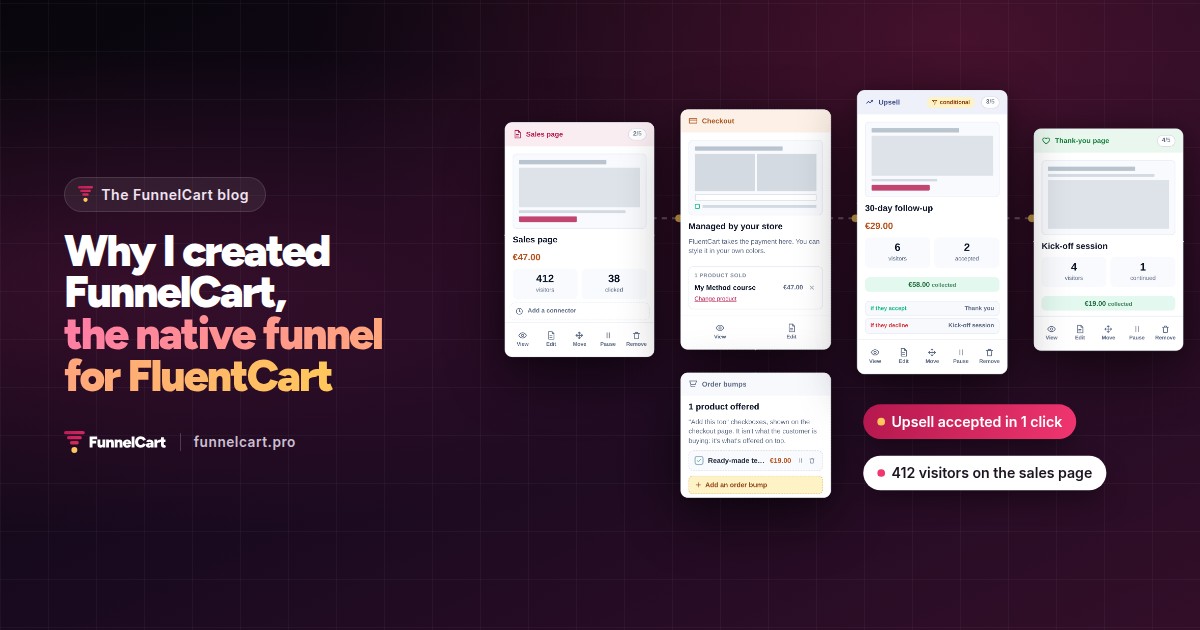
WordPress funnel plugins all rely on WooCommerce, pile up add-ons, and weigh down website speed. FluentCart arrived, lightweight and modern, without any funnel builder to match it. I created FunnelCart to fill that space: a complete sales journey, hosted on your server, with zero commission on your sales.
One Thursday evening, on a client’s site, I installed a well-known funnel plugin. It immediately installed three others in the process. Two hours later, the homepage had gained an extra second of load time, a cart checkbox was no longer returning anything, and the funnel still wasn’t live. Meanwhile, the client was just waiting to sell their course.
I went through that evening about ten times across different clients. Each time, the same impression: the tool was more complicated than the problem it was meant to solve. That’s where FunnelCart comes from.
Table of Contents
What’s wrong with today’s WordPress funnels
The existing funnel plugins on WordPress have real history behind them. CartFlows, FunnelKit, WPFunnels led the way, and their teams solved problems that no one had tackled before. I owe them part of what I know.
Yet they share three traits that end up weighing you down.
The first: they all require WooCommerce. WooCommerce is a great machine, designed for a catalog of hundreds of products, inventory, shipping, and variations. To sell a single course and an upsell, it is like driving a semi-truck just to pick up a loaf of bread.
The second: they rarely come alone. A funnel plugin, a payment plugin, an order bump plugin, an automation module, and sometimes an enforced theme. Each brick is fine on its own. Stacked together, they end up conflicting with one another, and even the slightest adjustment requires figuring out which one takes precedence.
The third: the bloat. Style sheets and scripts load everywhere, including on pages that have nothing to do with a funnel. The blog slows down, the homepage slows down, and the ads you pay for send visitors to a page that takes forever to load.
What it really costs, beyond the listed price
The price on the sales page is almost never the final price. You often need to add a payment gateway, a post-purchase upsell add-on, and an automation plugin. Over a year, the bill doubles without warning.
Then comes the time. Half a day to figure out which setting takes priority. Another to find out why an order was recorded twice. If you work in an agency, that time is either billed or lost—and most of the time, it is lost.
Finally comes speed, which costs you twice. A slow page converts less, so your sales drop. And because ad platforms evaluate the landing page experience, your clicks cost more for poorer results. You pay for the slowdown on both ends.
With subscription-based solutions, on the other hand, everything moves fast on day one. But your pages, your contacts, and your sales live on a third-party provider, a percentage is taken with every transaction, and the day you stop paying, your work tool shuts down.
How to recognize a healthy funnel tool
Before writing the first line of code for FunnelCart, I set up the checklist I wish I had had. It is not about FunnelCart. Use it to judge any tool, including mine.
- A single plugin to install : the funnel journey, complementary offers, routings, and statistics all in the same box.
- Loading limited to funnel pages : the rest of the site keeps its speed and SEO ranking.
- Your data stays with you : leads, orders, and statistics in your WordPress database, on your hosting.
- Zero commission : money goes directly from your payment gateway to your bank, without middlemen.
- Keep your page builder : Gutenberg, Elementor, Bricks, or Divi, without any forced theme.
- Clear numbers : what each funnel brings in, what each customer costs, without needing a spreadsheet on the side.
- A possible exit : your content remains WordPress pages, fully exportable, even if you change your mind.
For a long time, no tool ticked all seven boxes at once on WordPress. A piece was missing, and it was out of my hands.
Why FluentCart changed everything for me
The missing piece was the store engine. A sales funnel inevitably relies on an order engine : you need to collect payments, issue invoices, handle VAT, and track subscriptions. As long as this engine remained bloated, everything built on top of it became bloated too.
FluentCart was built from scratch for modern WordPress. Clean tables, fast code, a clear admin interface, and a foundation designed from the ground up for digital products, courses, and subscriptions. Today, in my eyes, it is the best way to run a store on WordPress.
And on the other side, nothing. Not a single funnel builder capable of connecting to it. The thousands of websites adopting FluentCart for its lightweight performance were left with a product page, a checkout, a thank-you page, and nothing after that. The most profitable moment of the day, right after checkout, remained an empty page.
I filled that void. FunnelCart was born from this : the best WordPress store deserved a sales engine worthy of it.
What FunnelCart does, and what it leaves to others
I built FunnelCart by going through the grid above, box by box.
A single plugin. You upload a file, enter your key, and a wizard guides you in seven steps. The funnel flow, order bumps, one-click post-purchase upsells, routing rules, A/B testing, and analytics are already there. There are no add-ons to purchase afterwards.
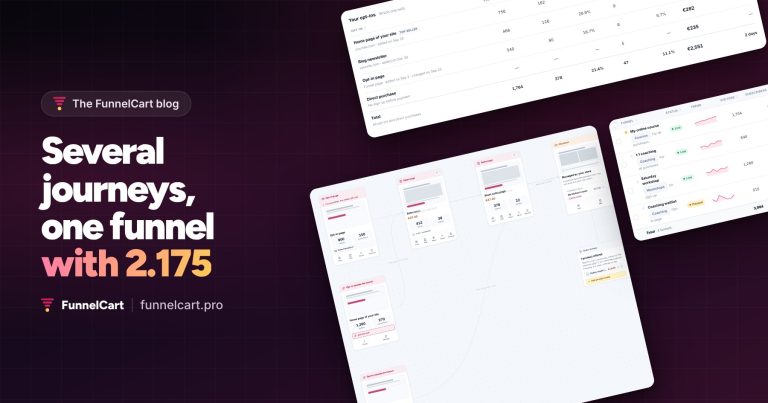
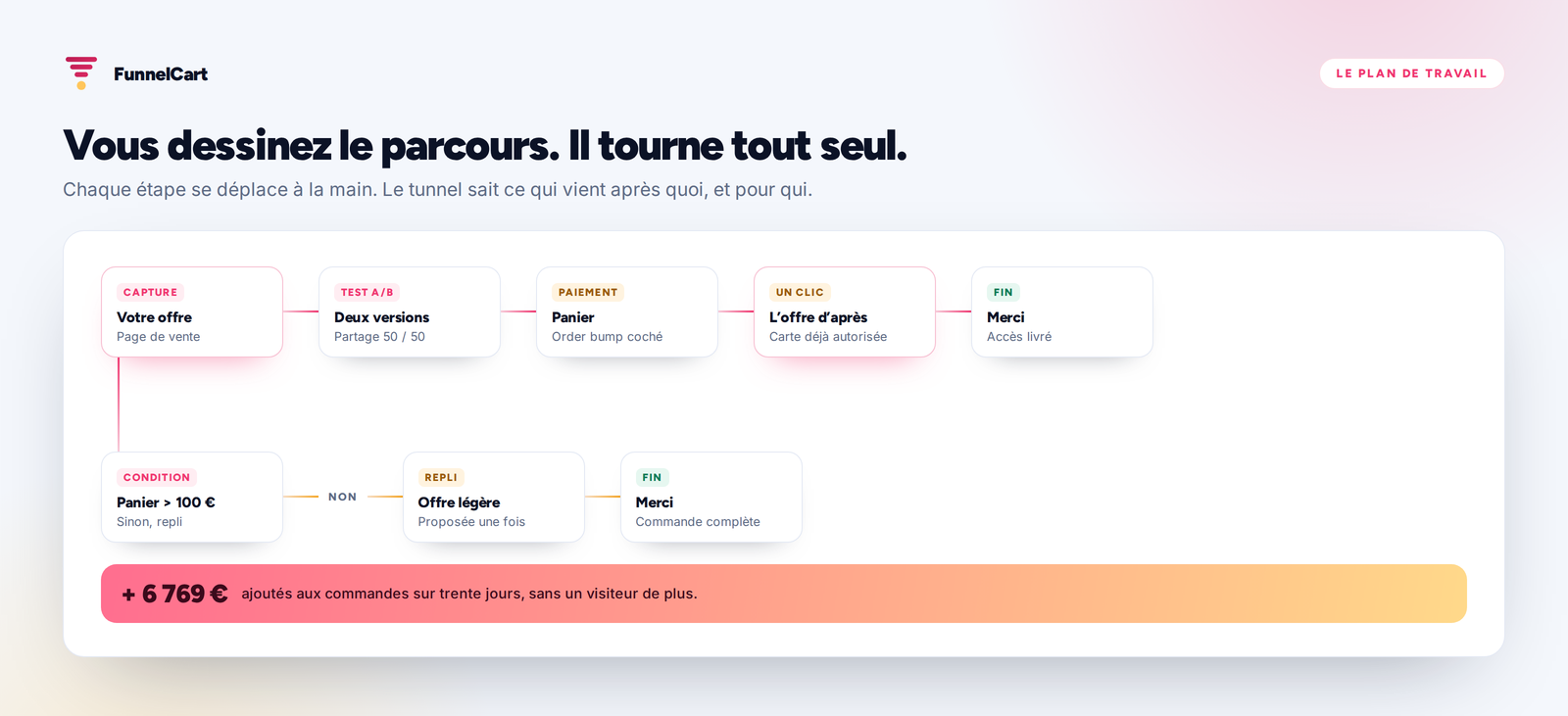
A visual canvas. You see your funnel like a map : each step is a card, each link an arrow. You move items around, connect a condition, and add a variant to test. You can see which step your prospects are on, directly on the visual diagram.
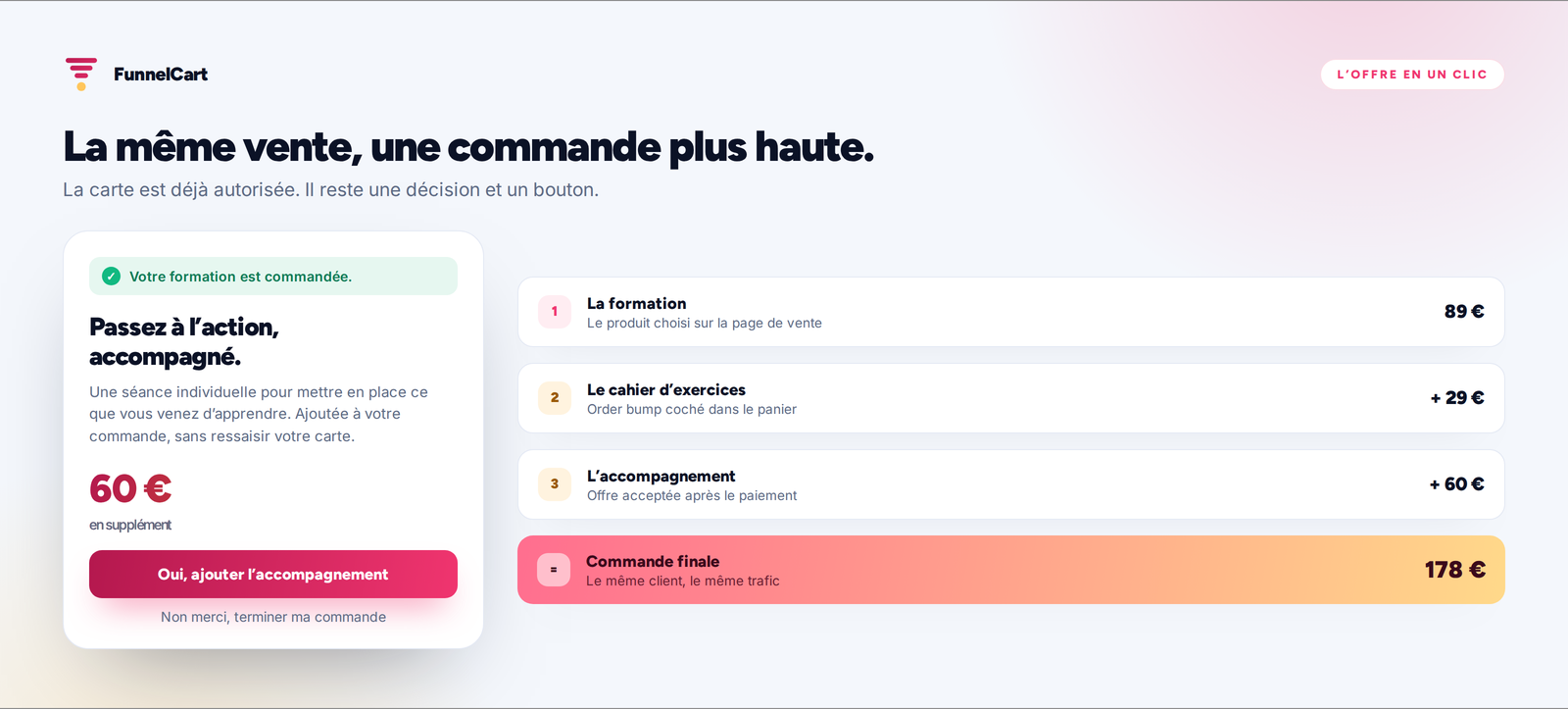
The post-purchase page. The card is already saved by your gateway. An additional offer is added to the order in one click, without re-entering details. Same traffic, same customers, higher average order value.
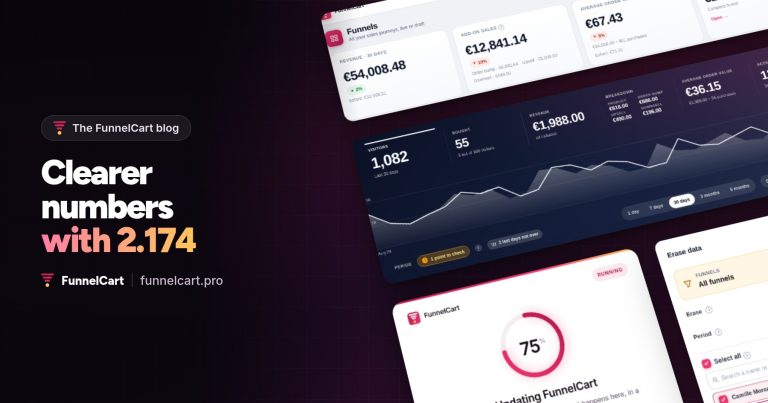
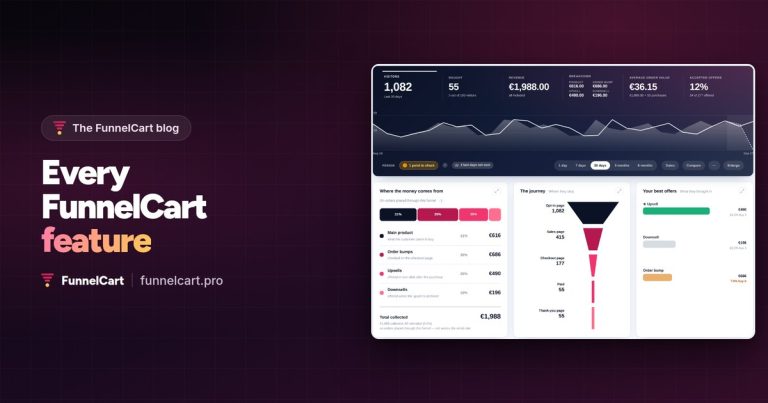
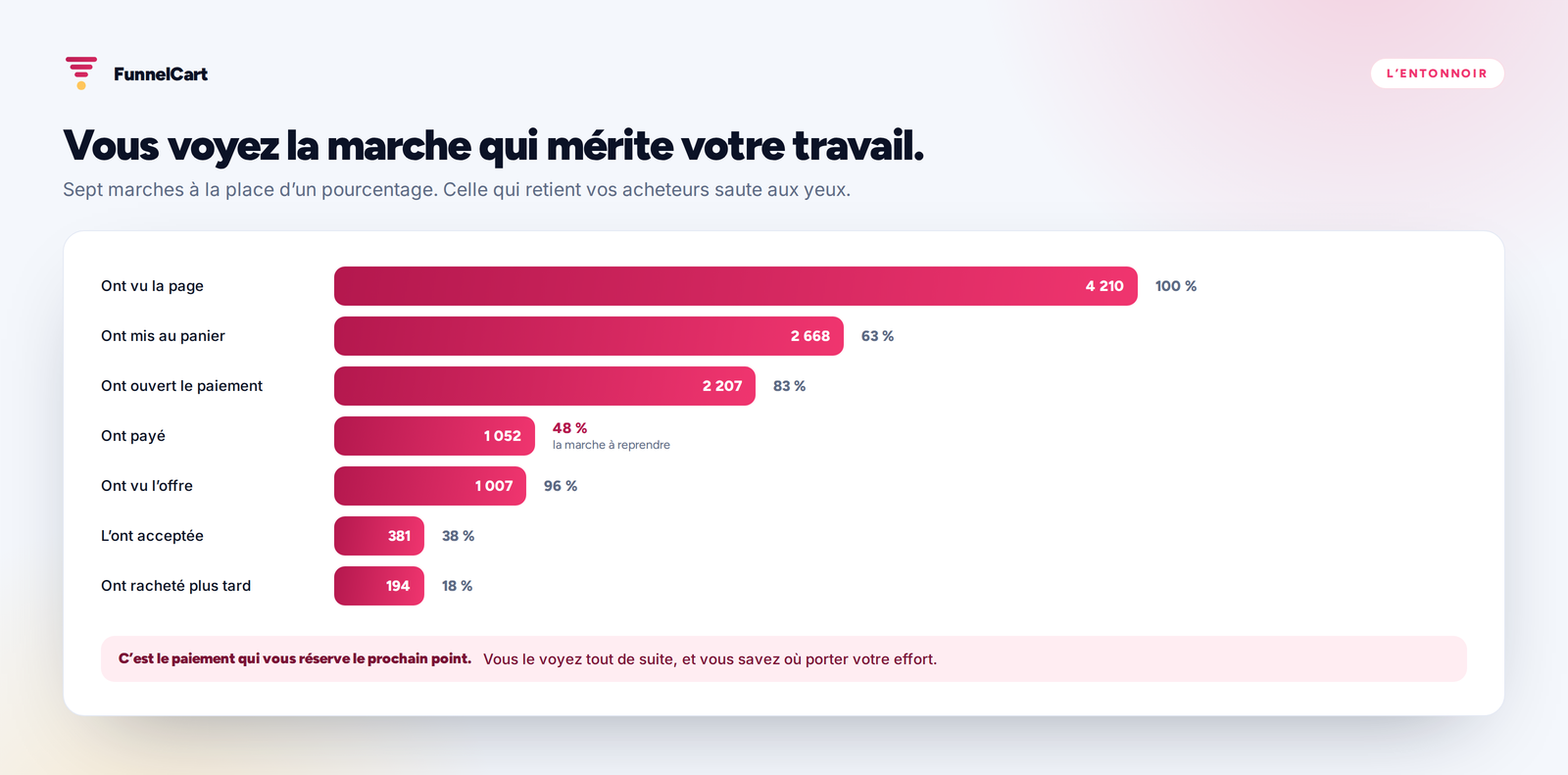
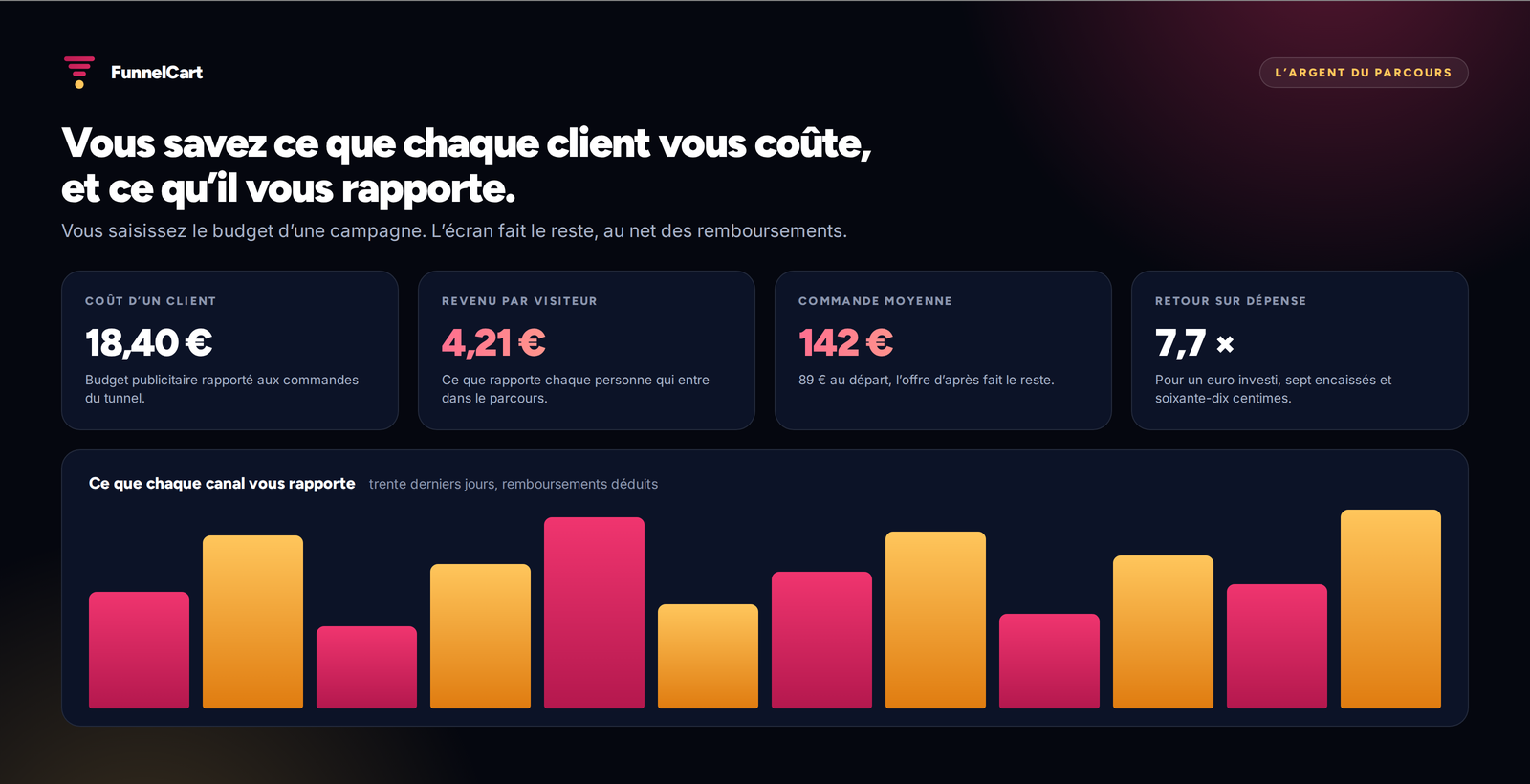
Your numbers, crystal clear. See in real time which ad is profitable, how much each customer costs and brings in, and which channel they came from. A read-only link lets you share these results with a partner or client without granting access to your admin panel.
On your own server, and under your name. Leads, orders, and statistics stay in your WordPress database. I don’t see anything that happens there. White labeling is included: your logo, your name, your colors, at no extra charge. The frequently asked questions details each of these points.
For agencies and freelancers setting up FunnelCart for multiple clients, everything remains standard WordPress: native pages, WordPress roles and permissions, webhooks to any tool, native connection with FluentCRM, one-click import from CartFlows, FunnelKit, or WPFunnels. A deployment can be replicated identically from one client to another, and the setup is billable.
The rest, I left to those who do it better. FunnelCart doesn’t process payments: FluentCart processes payments. FunnelCart doesn’t send your campaigns: FluentCRM sends them. FunnelCart doesn’t edit your pages: your page builder edits them. I take care of the step order, connections, visitor memory, and tracking.
What FunnelCart is not
FunnelCart requires the free version of FluentCart. If your store runs on WooCommerce and you have no intention of switching, existing tools will remain more suitable than mine. This is a deliberate choice: I prefer to do one thing very well on a modern foundation rather than two things halfway.
FunnelCart also requires your own WordPress site, with decent hosting and PHP 8.1. That is the price of freedom: owning your tool means having a place to host it.
Finally, the product is young. It is evolving quickly, updates are frequent, and some features will arrive after others. You can follow this progress on the blog and in the documentation, which are updated with each release.
Where to start
The easiest way is to see a funnel built live for your offer. Book a video demo, or browse the short videos showing every screen. Plans and what they include are detailed on the pricing page.
Frequently asked questions
Do you need FluentCart to use FunnelCart?
Yes. FunnelCart connects to FluentCart to collect payments for orders. The free version of FluentCart is enough to design your funnels and start accepting payments.
Why FunnelCart rather than CartFlows, FunnelKit, or WPFunnels?
These tools require WooCommerce and often come with additional plugins. FunnelCart fits into a single plugin built on FluentCart, only loads its scripts on funnel pages, and leaves the rest of your site at its original speed.
Why not choose a subscription SaaS like ClickFunnels ?
With FunnelCart, your funnels, pages, and contacts live on your own server. Your payments go directly from your payment gateway to your bank, with no commission fees deducted, and you stay in complete control of your business tools.
Does FunnelCart slow down my site ?
Stylesheets and scripts only load on funnel pages. Your homepage, blog, and store keep their performance and SEO.
Do you need to know how to code to create a funnel ?
No. A setup wizard guides you right from activation, and pre-built funnels prevent you from starting from a blank page. You adjust your copy and pricing in Gutenberg, Elementor, Bricks, or Divi, then publish.
Can I import my CartFlows, FunnelKit, or WPFunnels funnels ?
Yes. A built-in import tool takes the export file from your previous tool and reconstructs your steps, copy, and links.
Where is my leads’ data stored ?
In your WordPress database, on your web host. Consents are timestamped, the retention period is customizable, and both exporting and deletion are managed directly from your admin panel.
I run an agency: can I deploy FunnelCart for my clients?
Yes, within the limit of sites included in your license. White label is included, and a read-only link allows each client to track their own results without accessing your administration.